Question 1:
When you prepare to make a left turn from a one-way road into a one-way road, you must:
A
move into the right lane, or to the left side of a single lane.
B
move into the right lane, or to the right side of a single lane.
C
move into the left lane, or to the left side of a single lane.
The correct driving rule is: move into the left lane, or to the left side of a single lane. Following standard DMV road rules and practicing defensive driving ensures safety for all road users.
Question 2:
 What does this sign indicate?
A
The highway ahead is divided into two one-way roadways.
B
Winding road ahead. Drive with caution.
C
Drivers will soon be on a roadway with two-way traffic.
This traffic sign indicates: drivers will soon be on a roadway with two-way traffic. Observing and obeying all roadway signs ensures safe traffic flow and legal driving.
Question 3:
Which of the following must you obey over the others?
A
Red light
B
Stop sign
C
Police officer
The correct driving rule is: Police officer. Following standard DMV road rules and practicing defensive driving ensures safety for all road users.
Question 4:
While inside the roundabout, you should:
A
remain in your lane until you are ready to exit.
B
change lanes before you check for vehicles behind you.
C
use your left turn signal if you are in position to exit now.
Vehicles entering a roundabout must yield right-of-way to circulating traffic already inside: remain in your lane until you are ready to exit. Wait for a safe gap before entering.
Question 5:
 This road sign means:
A
Church ahead
B
Intersection ahead
C
Do not enter
D
Side road
This traffic sign indicates: Intersection ahead. Observing and obeying all roadway signs ensures safe traffic flow and legal driving.
Question 6:
 When drivers see this road sign:
A
they must come to a complete stop and call the police.
B
they must not drive past this sign.
C
they must turn around immediately.
This traffic sign indicates: they must turn around immediately. Observing and obeying all roadway signs ensures safe traffic flow and legal driving.
Question 7:
The yield sign is ___ and white, with ___ letters.
A
yellow; black
B
red; red
C
red; white
The correct driving rule is: red; red. Following standard DMV road rules and practicing defensive driving ensures safety for all road users.
Question 8:
If another vehicle passes you on the left, you must:
A
increase your speed slightly and keep to the right.
B
decrease your speed, then pull over to the right and stop.
C
decrease your speed slightly and keep to the right.
The correct driving rule is: decrease your speed slightly and keep to the right. Following standard DMV road rules and practicing defensive driving ensures safety for all road users.
Question 9:
Regulation signs normally are ____ rectangles with ____ letters or symbols.
A
yellow; black
B
white; black
C
green; white
The correct driving rule is: white; black. Following standard DMV road rules and practicing defensive driving ensures safety for all road users.
Question 10:
When driving through a curve, you should:
A
speed up as you enter, slow down as you exit.
B
stay near the right of your lane.
C
maintain constant speed.
D
slow as you enter, speed up as you exit.
The correct driving rule is: slow as you enter, speed up as you exit. Following standard DMV road rules and practicing defensive driving ensures safety for all road users.
Question 11:
 This road sign means:
A
No left turn
B
No U-turn
C
Detour ahead
This traffic sign indicates: No U-turn. Observing and obeying all roadway signs ensures safe traffic flow and legal driving.
Question 12:
As you approach an intersection, the traffic light changes from green to yellow. You should:
A
apply the brakes sharply and come to a complete stop.
B
be prepared to stop before the intersection.
C
be prepared to stop in the middle of the intersection.
D
speed up to beat the red light.
According to standard right-of-way regulations: be prepared to stop before the intersection. Yielding appropriately prevents intersection collisions and maintains safe traffic flow.
Question 13:
When a driver is turning and a pedestrian is crossing without a traffic light, __________ must yield the right-of-way.
A
the pedestrian
B
the driver
C
both
D
whoever is slower
Drivers must always yield the right-of-way to pedestrians crossing at intersections and crosswalks: the driver. Stop and allow them to clear the lane safely.
Question 14:
Double solid lines on the roadway mean:
A
you cannot pass.
B
you can not go across the lines except to turn left to enter or leave the highway.
C
All of the above.
All of the listed points are essential driving requirements: you cannot pass; you can not go across the lines except to turn left to enter or leave the highway. Practicing each ensures compliance with DMV safety laws.
Question 15:
 This sign warns drivers that:
A
the highway ahead is divided into two one-way roadways. Drivers should keep to the right.
B
there is a winding road ahead.
C
there is a double curve ahead.
This traffic sign indicates: there is a double curve ahead. Observing and obeying all roadway signs ensures safe traffic flow and legal driving.
Question 16:
If you are continually being passed on the right, you should:
A
move into the right lane and allow other vehicles to pass you on the left.
B
move into the left lane and allow other vehicles to pass you on the right.
C
increase your speed immediately.
The correct driving rule is: move into the right lane and allow other vehicles to pass you on the left. Following standard DMV road rules and practicing defensive driving ensures safety for all road users.
Question 17:
An emergency vehicle that uses lights and a siren can be unpredictable. Why?
A
The driver can legally pass red lights.
B
Emergency vehicles must go faster than the posted speed limit when it is safe to do so.
C
Emergency vehicle drivers are not required to be careful.
When sharing the road with other vehicles: The driver can legally pass red lights. Giving large vehicles and vulnerable users adequate clearance prevents dangerous accidents.
Question 18:
If you are 18 years or older with four traffic convictions in 24 months, you will get a:
A
six months suspension.
B
90 days restriction.
C
eighteen months suspension.
D
30 days suspension.
The correct driving rule is: 30 days suspension. Following standard DMV road rules and practicing defensive driving ensures safety for all road users.
Question 19:
Before entering a traffic circle, drivers must slow down and yield to ___________ in the traffic circle.
A
pedestrians
B
vehicles
C
bicyclists
D
All of the above.
Safe navigation at intersections requires following all established rules: pedestrians; vehicles; bicyclists. Always yield right-of-way properly to prevent collisions.
Question 20:
When you reach an intersection with a stop sign, you should:
A
follow the vehicle ahead of you.
B
stop, look right, then left, then right again.
C
stop, look left, then right, then left again.
D
check your rearview mirror, look left, then right, then proceed.
According to standard right-of-way regulations: stop, look left, then right, then left again. Yielding appropriately prevents intersection collisions and maintains safe traffic flow.
Question 21:
What is the main reason night driving is more difficult than daytime driving?
A
The use of headlight is required by law.
B
Reduced visibility.
C
Driving within the range.
The correct driving rule is: Reduced visibility. Following standard DMV road rules and practicing defensive driving ensures safety for all road users.
Question 22:
 This road sign means:
A
Truck stop ahead
B
No trucks allowed
C
Hill or downgrade up ahead
This traffic sign indicates: Hill or downgrade up ahead. Observing and obeying all roadway signs ensures safe traffic flow and legal driving.
Question 23:
 This sign means:
A
Not enter
B
Detour to the right
C
The road to the right is for one-way traffic only
This traffic sign indicates: Detour to the right. Observing and obeying all roadway signs ensures safe traffic flow and legal driving.
Question 24:
The ‘Slower Traffic Keep Right’ sign is used:
A
at most intersections.
B
on multiple lane highways.
C
in school zones.
The correct driving rule is: on multiple lane highways. Following standard DMV road rules and practicing defensive driving ensures safety for all road users.
Question 25:
 This sign warns drivers of:
A
a side road.
B
a sharp turn.
C
a cross road.
This traffic sign indicates: a sharp turn. Observing and obeying all roadway signs ensures safe traffic flow and legal driving.
Question 26:
When entering a crowded freeway, to merge into traffic you should:
A
yield to vehicles already on the freeway.
B
use the acceleration lane to adjust your speed to the same speed as freeway traffic.
C
check your blind spots.
D
All of the above.
Defensive driving best practices include: yield to vehicles already on the freeway; use the acceleration lane to adjust your speed to the same speed as freeway traffic; check your blind spots. Staying alert and maintaining spacing prevents unexpected hazards.
Question 27:
When changing lanes, __________ to be sure no one is in the 'blind spot'.
A
check your right mirror
B
slow down gradually
C
check your left mirror
D
glance over your shoulder
Large commercial trucks have extensive blind spots on all four sides called the 'No-Zone': glance over your shoulder. If you cannot see the truck driver in their side mirrors, they cannot see you.
Question 28:
Worn tires:
A
may cause you to hydroplane even with very little water on the road.
B
can increase your stopping distance.
C
can make turning more difficult.
D
All of the above.
All of the listed points are essential driving requirements: may cause you to hydroplane even with very little water on the road; can increase your stopping distance; can make turning more difficult. Practicing each ensures compliance with DMV safety laws.
Question 29:
 This road sign means:
A
Railroad Warning
B
Stop Sign Ahead
C
Lane ends
D
Stop if necessary
This traffic sign indicates: stop Sign Ahead. Observing and obeying all roadway signs ensures safe traffic flow and legal driving.
Question 30:
When you are in a line of traffic that is crossing a railroad track that has no signals or gates:
A
you may pass slower drivers crossing the track.
B
before you start to cross, you need to make sure there is space to get all the way across the tracks without stopping.
C
you have the right of way and do not need to check for trains.
D
All of the above.
The correct driving rule is: before you start to cross, you need to make sure there is space to get all the way across the tracks without stopping. Following standard DMV road rules and practicing defensive driving ensures safety for all road users.
Question 31:
When making a turn, drivers must _____ their speed.
A
reduce
B
maintain
C
increase
D
double
For safe speed and stopping control: reduce. Adjusting speed to match visibility and road traction prevents loss of steering grip.
Question 32:
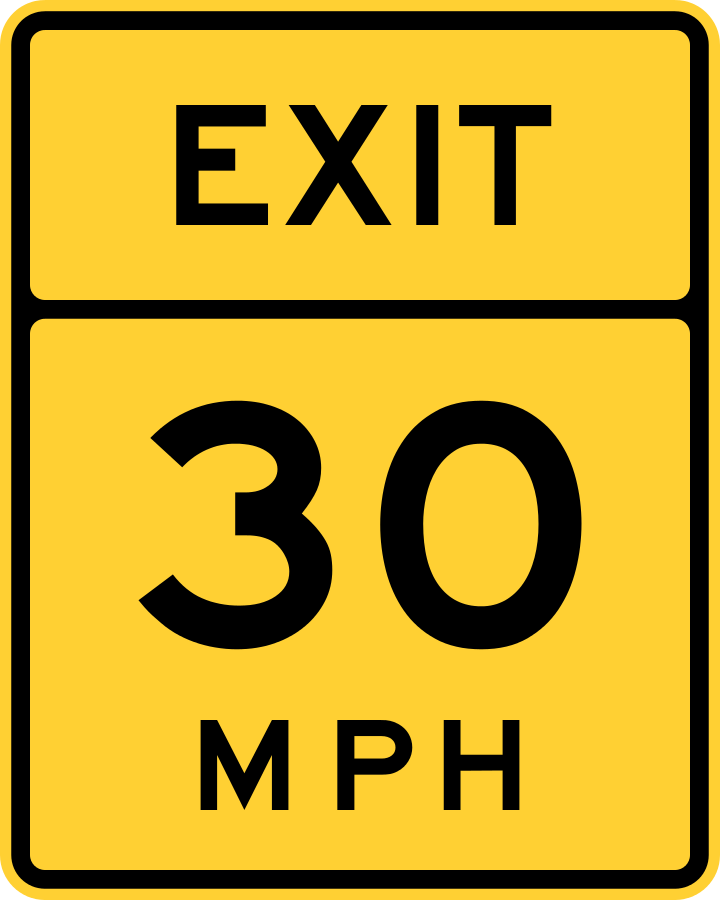 The sign in the picture:
A
shows the highest speed drivers can travel at the exit of the intersection.
B
is used to advise motorists of the appropriate ramp speed at the highway exit point.
C
indicates the minimum ramp speed at the highway exit point.
The correct driving rule is: is used to advise motorists of the appropriate ramp speed at the highway exit point. Following standard DMV road rules and practicing defensive driving ensures safety for all road users.
Question 33:
When approaching a highway-rail intersection, the first sign drivers see is usually:
A
an RXR round sign on a yellow background.
B
a stop sign.
C
a yield sign.
According to standard right-of-way regulations: an RXR round sign on a yellow background. Yielding appropriately prevents intersection collisions and maintains safe traffic flow.
Question 34:
If a vehicle is approaching with high beams, drivers should look __________ until the vehicle passes.
A
to the right of the road
B
at the center of the road
C
to the left of the road
D
straight ahead
The correct driving rule is: to the right of the road. Following standard DMV road rules and practicing defensive driving ensures safety for all road users.
Question 35:
Which shape is a yield sign?
A
Vertical rectangle
B
Upside-down triangle
C
Diamond
The correct driving rule is: Upside-down triangle. Following standard DMV road rules and practicing defensive driving ensures safety for all road users.